Drywall Cost Calculator
Price the whole job: board, finishing materials and labor as separate lines, with an installed total. Enter your own price per sheet and labor rate per square foot for a number that matches your market.
- Material + labor lines
- Installed total
- Your own rates
- Quote sanity check

Your estimate
4' x 8' sheets · 10% waste allowance4' x 8' drywall
Area
Materials
Cost breakdown
Quantities include a 10% waste allowance and standard deductions of 21 sq ft per door, 15 sq ft per window and 112 sq ft per garage door. The sheet count comes from laying the board out wall by wall, plus 10% as spare sheets. Round up when in doubt, an extra sheet costs less than a second trip.
A drywall cost calculator has to separate three very different numbers: the board, the finishing materials, and the labor to hang and finish it. Board is the easiest and the smallest, usually under a quarter of an installed price. Labor is the largest and the most variable. This page keeps the three as separate lines so you can compare a contractor quote against your own material cost and see exactly where the money is going.
The three lines in a drywall price
- Board. Sheet count times your price per sheet. A 4x8 half inch sheet is commonly $12 to $20 in the US, so roughly $0.40 to $0.65 per square foot.
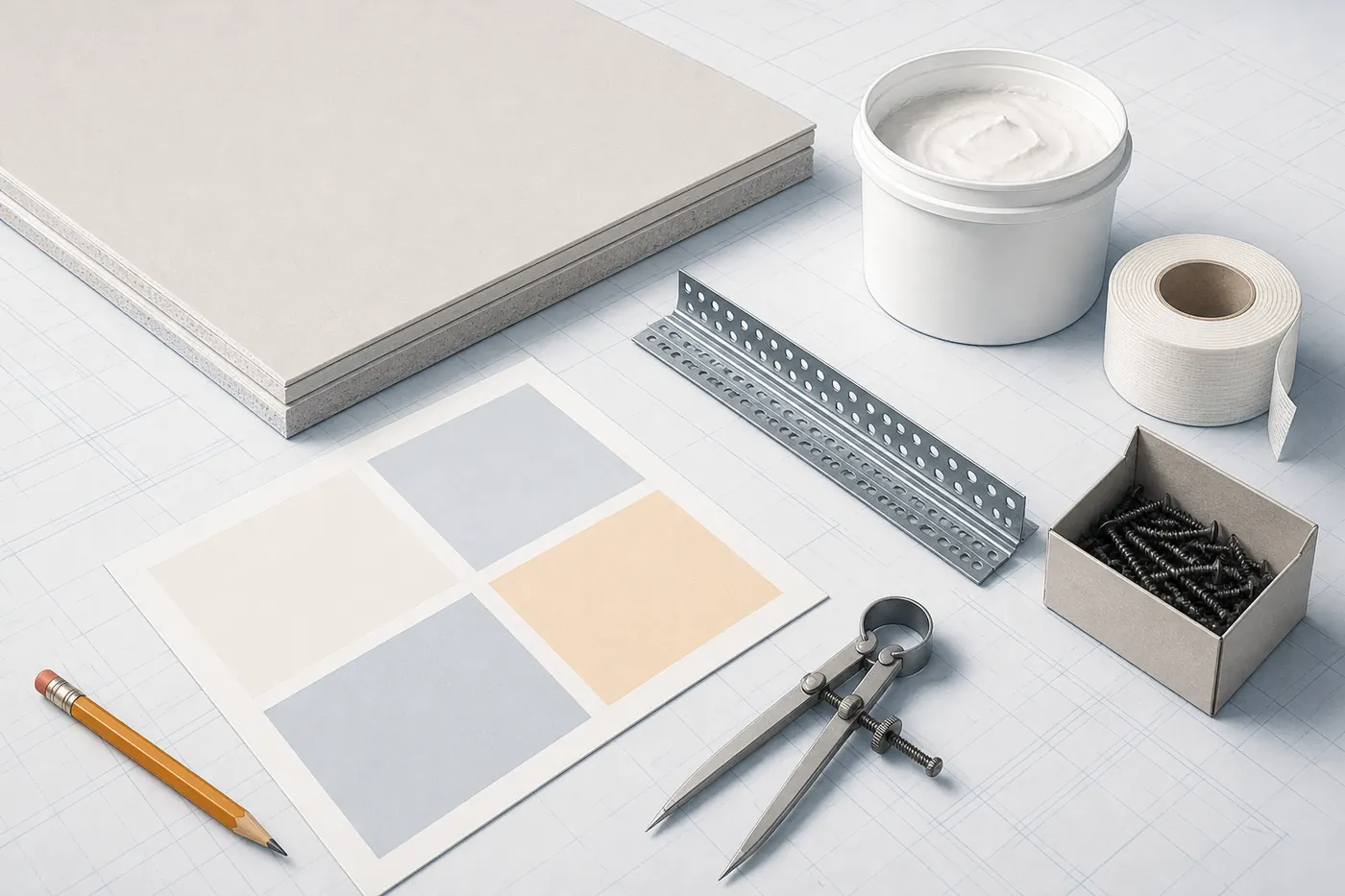
- Finishing materials. The calculator prices the compound, tape and screws on your shopping list at $18 per 4.5 gallon box, $5 per 250 ft roll and $8 per pound of screws, usually $0.10 to $0.15 per square foot. Corner bead and primer are extra.
- Labor. Hanging and finishing runs about $1.20 to $2.50 per square foot for standard residential work, more for high ceilings, curves, or a level 5 finish.
Added together, an installed price of roughly $1.80 to $3.30 per square foot of drywall covers most straightforward residential jobs. That is per square foot of board, not per square foot of floor, which is the distinction that makes quotes look inconsistent when they are not.
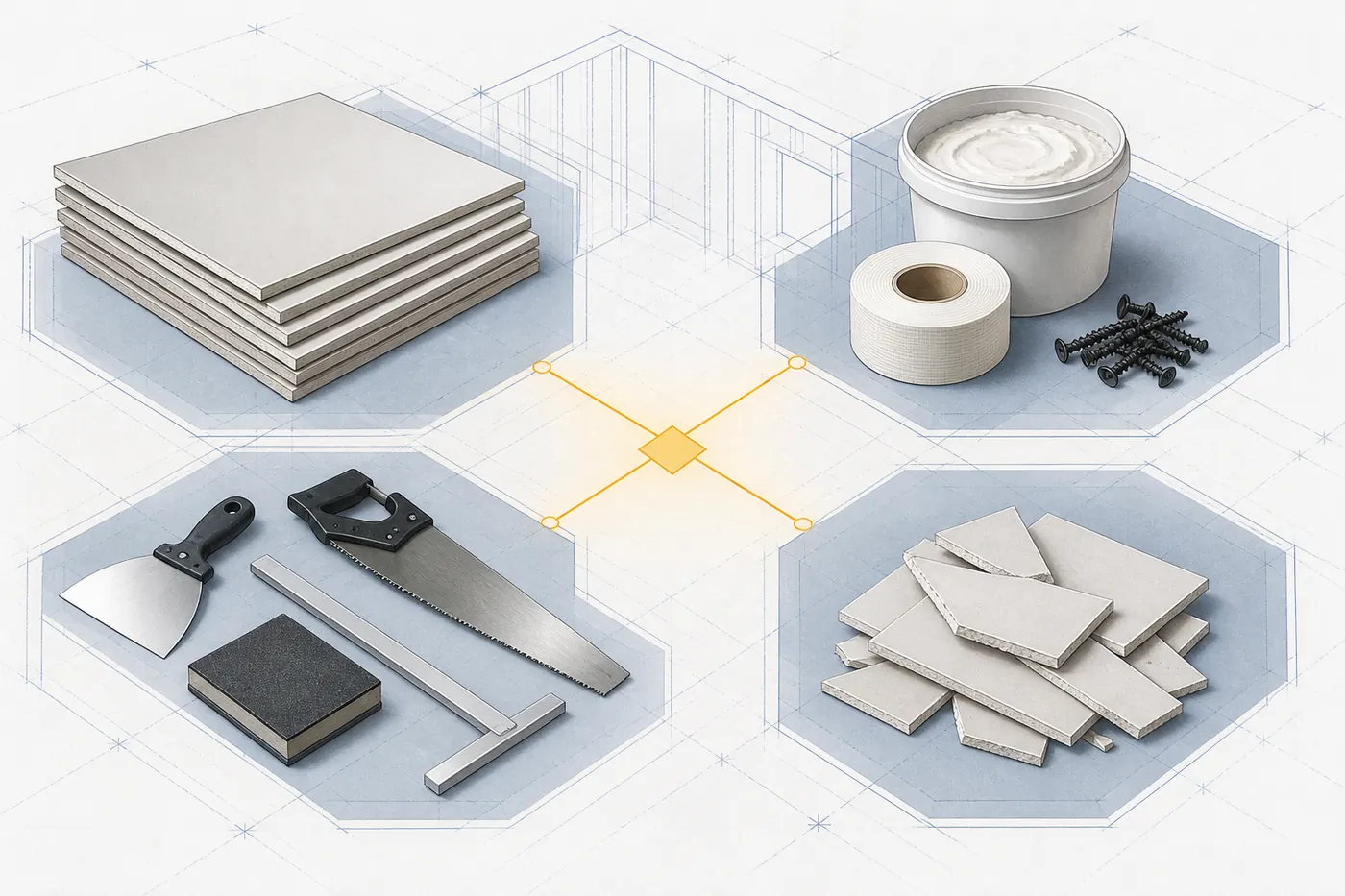
How the cost estimate is built
- Work out total drywall area: walls minus openings, plus the ceiling if it is in scope.
- Add the waste allowance and divide by the sheet area to get a sheet count, rounded up, or use the 4 ft row layout count if that is higher.
- Board cost = sheets x your price per sheet.
- Finishing cost = compound boxes x $18 + tape rolls x $5 + pounds of screws x $8, if you include finishing materials.
- Labor cost = total area x your labor rate per square foot.
- Installed total = board + finishing + labor.
Board is priced on the sheet count, which includes waste, because you pay for the sheets you buy. Finishing is priced on the boxes, rolls and screws you buy, which follow the sheet count. Labor is priced on the net area, because a crew charges for the surface they cover, not for your offcuts.
Worked example: pricing a 14 by 12 bedroom
A 14 ft by 12 ft bedroom with 8 ft ceilings, one door, two windows, walls and ceiling, in 4x8 sheets at $16, finishing materials included, labor at $1.65 per square foot.
- Net wall area: (2 x (14 + 12) x 8) - 51 = 365 sq ft.
- Ceiling area: 14 x 12 = 168 sq ft. Total area: 533 sq ft.
- With 10% waste: 586.3 sq ft. Sheets: 586.3 / 32 = 18.32, so 19 sheets.
- Board: 19 x $16 = $304.
- Finishing materials: 2 boxes of compound at $18, 1 roll of tape at $5 and 3 lb of screws at $8 = $65.
- Labor: 533 x $1.65 = $879.
- Installed total: $1,248, which is $2.34 per square foot of drywall.
Doing it yourself removes the labor line, leaving roughly $369 in materials, so a DIY bedroom is about 30% of the installed price. That is the real trade-off to weigh: the savings are large in percentage terms, and the work is a few long days plus a rented lift if the ceiling is included.
What moves a drywall quote up or down
- Finish level. A level 4 finish is standard for painted walls. Level 5, a full skim coat, adds roughly 20% to 30% to the finishing labor and is worth it under gloss paint or raking light.
- Ceiling height. Anything over 9 ft means staging or stilts, and the labor rate rises accordingly.
- Ceilings versus walls. Overhead work carries a premium of 20% to 40% on labor for the same area.
- Specialty board. Moisture resistant, mold resistant, type X fire rated and sound damping panels all cost more per sheet than standard board.
- Access and cleanup. Third floor with no elevator, or a job where debris removal is included, both add real cost.
- Repairs rather than new work. Patching is priced by the hour or by the patch, not by the square foot, because the setup dominates.
Using this to compare contractor quotes
The most useful thing a homeowner can do with a drywall estimate is convert every bid to the same unit and then ask about the difference.
- Run your room dimensions through the calculator to get the total drywall square footage.
- Divide each quote by that square footage to get an installed price per square foot.
- Ask each contractor which finish level is included, and whether priming, debris removal and corner bead are in the price.
- Confirm who supplies and stocks the board, since a supplier delivery to the room is worth real money.
- Treat an outlier in either direction as a question, not a decision. A low bid usually means something is excluded.
None of this replaces a site visit or a supplier takeoff. It does mean you walk into the conversation knowing the square footage, the sheet count and a defensible range, which is usually enough to keep an estimate honest.